Target Cost per Acquisition: How to Set One You Can Defend
Most target CPAs come from last year's number minus ten percent. Deriving one from gross margin and payback, then cascading it to cost per meeting.
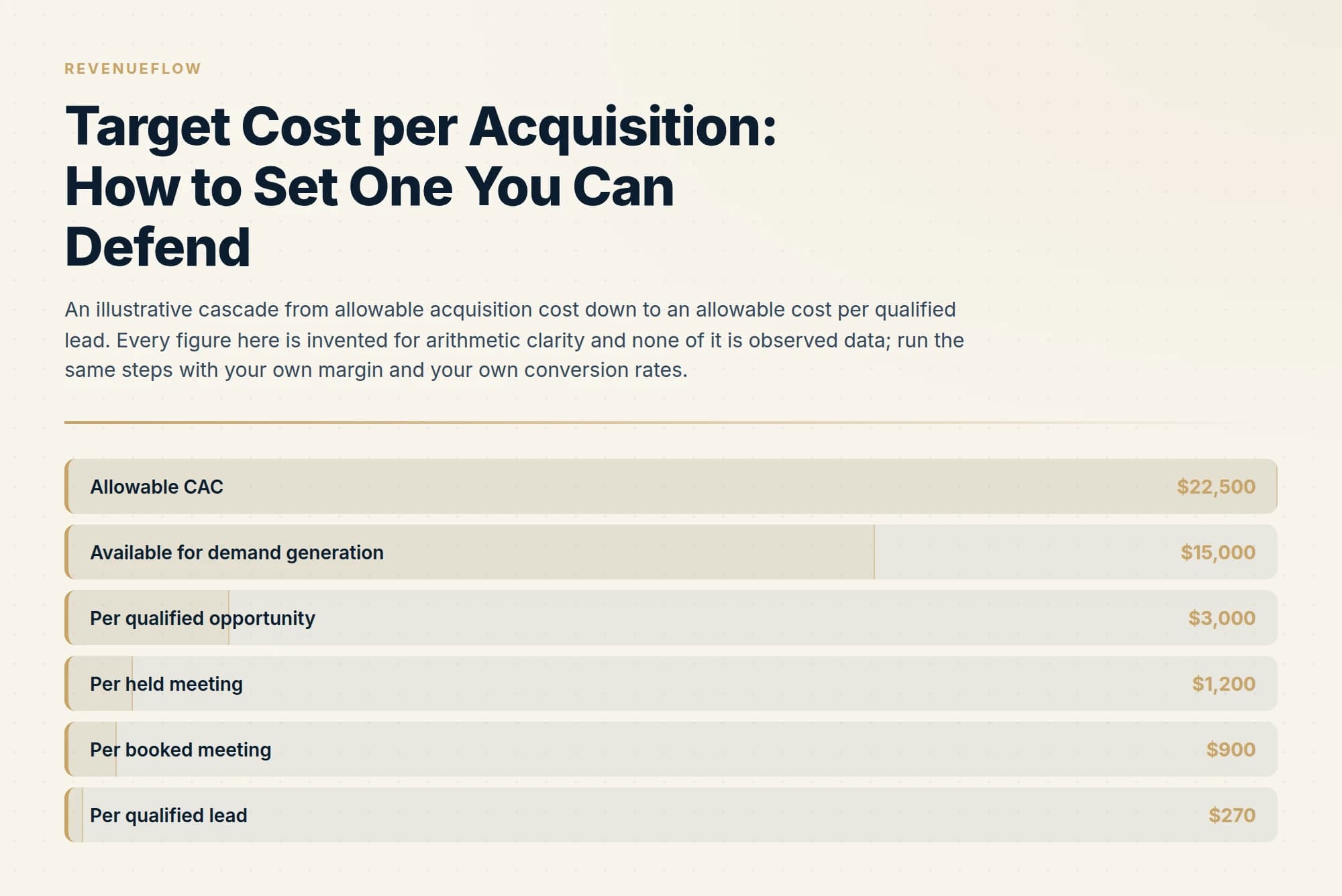
A target cost per acquisition is the most you can spend to win one customer and still recover it within a chosen payback period. Set it from monthly gross profit per customer multiplied by the months of payback you accept, subtract the loaded cost of closing, then cascade the remainder down the funnel using your own conversion rates.
Key takeaways
- A defensible target CPA starts from gross profit per customer and a payback tolerance chosen from the cash position, never from revenue or a category benchmark.
- Allowable acquisition cost is monthly gross profit times payback months, and the loaded cost of closing has to be subtracted before the rest is cascaded.
- Cascading with your own conversion rates gives an allowable cost per opportunity, per meeting and per qualified lead, so a buyer can judge a quote in seconds.
- The model breaks on small samples, loose stage definitions, churn inside the margin, segment mix and marginal cost, and each has a specific correction.
Reviewed and updated September 18, 2026
Most target CPAs are set one of three ways: last year's actual with ten percent shaved off it, a figure a competitor mentioned on a podcast, or the number that makes the plan work when you solve the spreadsheet backwards from the growth target. All three produce a number nobody can defend when it is missed, because none of them started from anything the business actually knows about itself.
Before trusting any allowable number, check whether it merely echoes a platform's reported CPA rather than true acquisition cost, a gap explored in what the platform number leaves out.
A target you can defend starts from gross margin and a payback tolerance, and it ends as a set of allowable costs at every stage of the funnel, so the person buying media or booking meetings knows their own ceiling without having to reason about lifetime value.
A ceiling is only useful against a quotable price, and the nine factors that move Salesgenie's published floor show what a data buyer can settle before the quote conversation.
What is a target cost per acquisition?
A target cost per acquisition is the most you can afford to spend to win one new customer and still get the money back in a period you have chosen. It is set from your own numbers: monthly gross profit per customer multiplied by the months of payback you will accept. That gives an allowable acquisition cost, which is then divided down the funnel into an allowable cost per opportunity, per meeting and per qualified lead.
Start from gross profit, and from cash
Teams with no closing rate data on outbound can still set a defensible target, because this method starts from gross profit rather than from a historical conversion rate, and the first quarter of sending is what supplies the rate afterwards.
Revenue is the wrong starting point. A dollar of revenue at 40 percent margin buys you less acquisition than a dollar at 85 percent, and a target CPA built on revenue silently assumes margins you may not have.
The two inputs that set the ceiling are gross profit per customer and how long you are willing to wait to get it back.
Gross profit per customer is annual contract value multiplied by gross margin, with margin computed properly: hosting, support, delivery headcount, payment processing, any third party fee that scales with usage. For a transactional business, substitute gross profit per order multiplied by the number of orders you can honestly expect inside a defined window, using the repeat behaviour you have already observed rather than the one in the plan.
Payback tolerance is the number of months of that gross profit you are willing to spend to win the customer. This is a cash decision before it is a marketing decision. A company with two years of runway and a company with seven months can look at identical unit economics and correctly choose different tolerances. Anyone with meaningful working capital constraints should set tolerance from the cash they can be out of pocket at peak, not from a benchmark for their category.
Allowable acquisition cost is those two multiplied together. Monthly gross profit times the number of months of payback you will accept. That is the ceiling, and everything downstream is a division of it.
Subtract the cost of closing before you cascade

The step almost every model skips: allowable CAC covers every cost of acquiring the customer, and closing is one of those costs. The account executive's loaded salary, their commission, the sales engineer on the technical call, the CRM seats. If you cascade the full allowable down the funnel, you will authorise a cost per meeting that leaves nothing to pay the person who takes the meeting.
Compute loaded sales cost per new customer, subtract it from allowable CAC, and cascade what remains. That residual is the honest demand generation budget per customer, and it is usually a sobering fraction of the headline number.
A worked illustration with chosen inputs
Run in the other direction, this cascade is how to calculate ROI on qualified meetings, which is what a buyer is asking for when they want to model a supplier against assumed win rates. Start from the meeting count rather than from the allowable, multiply up through the same four rates, and compare the resulting gross profit against what the meetings cost.
Everything in this section uses invented figures, picked because they divide cleanly. They are an illustration of the method rather than typical values, and substituting your own numbers is the entire point of the exercise.
Assume a business selling a $30,000 annual contract at 75 percent gross margin. Annual gross profit per customer is $22,500, so monthly gross profit is $1,875.
Assume the company chooses a 12 month payback tolerance, based on its own cash position. Allowable CAC is 12 times $1,875, which is $22,500.
Assume loaded sales cost, meaning the closing team's salary, commission and tooling divided by new customers won, comes to $7,500 per new customer. Subtracting it leaves $15,000 of allowable demand generation cost per new customer.
Now cascade using the company's own observed conversion rates. Assume 20 percent of qualified opportunities become customers, 40 percent of held meetings become qualified opportunities, 75 percent of booked meetings are actually held, and 30 percent of qualified leads become booked meetings.
Twenty percent win rate means each opportunity is worth one fifth of a customer, so the allowable cost per opportunity is 20 percent of $15,000, which is $3,000. Forty percent of held meetings becoming opportunities gives an allowable of $1,200 per held meeting. A 75 percent show rate gives $900 per booked meeting. Thirty percent of qualified leads converting to booked meetings gives $270 per qualified lead.
That last figure is the one that changes behaviour. A team that knows its allowable is $270 per qualified lead can evaluate a channel, a list source or a supplier quote in about ten seconds, without escalating and without reasoning about lifetime value in the meeting.
The mechanics of buying leads at a fixed price are covered in pay per lead software, including the attribution and duplicate disputes that erode a clean allowable.
Where the model breaks

Conversion rates from small samples. A 20 percent win rate computed from fifteen opportunities is an anecdote with a percent sign attached. The cascade multiplies four such estimates together, and the error compounds. Where the sample is thin, use a wide band rather than a point estimate, plan against the pessimistic end, and treat the optimistic end as upside rather than as the budget.
Stage definitions that mean different things to different people. The cascade only works if a qualified opportunity means the same thing every time it is counted. Loose stage definitions inflate the middle of the funnel, which inflates the allowable at every stage below it, which authorises overspending on exactly the leads that were never going to convert. The distinction between an MQL and an SQL is not a taxonomy argument when a budget ceiling is derived from it.
Churn hiding inside the margin. Payback tolerance is only safe if customers survive it. A twelve month payback against a product with heavy first year churn means a meaningful share of customers never repay their acquisition cost at all. Where retention is weak, either shorten the tolerance or compute against the gross profit actually realised in the first year rather than the contracted amount.
Mix. One target CPA across segments that convert differently will overpay in the weak segment and underpay in the strong one. If enterprise wins at half the rate of mid market at three times the contract value, those are two targets. Set them separately, which usually means writing the ideal customer profile precisely enough that a lead can be assigned to a segment before it is priced.
Average against marginal. The allowable is an average ceiling. The cost of the next unit of volume in a channel is typically higher than the cost of the last, because the most responsive audience is reached first. A channel sitting exactly at the allowable is already unprofitable at the margin.
| Where it breaks | What it does | The correction |
|---|---|---|
| Rates from small samples | Four thin estimates multiplied together, and the error compounds | Use a band, and plan against the pessimistic end |
| Loose stage definitions | Inflates the middle of the funnel and every allowable below it | Write the definitions down and apply them the same way every time |
| Churn inside the margin | Customers who leave early never repay their acquisition cost | Shorten the tolerance, or use first year gross profit actually realised |
| Segment mix | One target overpays in the weak segment and underpays in the strong one | Set a separate target per segment |
| Average against marginal | The next unit of volume costs more than the last | Treat a channel sitting at the allowable as already unprofitable at the margin |
Making the target defensible in a room
A target survives challenge when the challenger can see which input they disagree with. Publish the target with its inputs attached: margin, payback tolerance, loaded closing cost, and the four conversion rates with the sample size behind each. Then a disagreement becomes an argument about a specific rate rather than about whether the number feels right.
Two habits matter as much as the arithmetic. Review on a fixed cadence, quarterly for most companies, and change the target only when an input has actually moved rather than because performance was disappointing. Moving the target to match the result is how a target stops meaning anything. And record the change with its reason when it does move, so a target that has crept upward over four quarters is visible as a trend rather than as four separate reasonable decisions.
A derivation
- It derives from gross profit, not revenue
- Payback tolerance was chosen from the cash position and written down
- Loaded closing cost was subtracted before cascading
- Each conversion rate has a sample size recorded next to it
- Separate targets exist for segments that convert differently
- Stage definitions are written and applied consistently
- The target moves only when an input moves
An opinion
- The target was set by working backwards from the growth plan
- The target came from a benchmark for the category
- First year churn is not yet reflected in the payback tolerance
What to do when you keep missing it

A target missed consistently is information, and the useful first question is which stage is missing it. The cascade makes that answerable, because each stage has its own allowable and its own actual. Overspending at the meeting stage while converting above plan at the opportunity stage is a different problem from the reverse, and they have opposite remedies.
If the miss is concentrated at the top, the pool or the targeting is wrong, and buying more of the same audience will not fix it. If the miss is in show rate or in meeting quality, the definition of a qualified meeting is doing less work than it should. Where meetings are bought from a supplier, the definition needs to be agreed in writing before anything launches, covering audience, buyer responsibility, the prospect agreeing to a relevant business conversation, attendance, and exclusion of accounts already disclosed as customers or open opportunities. Budget, timing and decision authority do not belong in that definition, because they describe how the conversation goes rather than whether the right conversation happened. Our breakdown of pay per appointment pricing in B2B covers what that definition has to contain to be enforceable, and outsourced SDR pricing covers how the same ceiling compares against a headcount model.
If the miss is at the bottom, the win rate assumption was wrong, and the honest response is to lower the allowable rather than to keep spending against a rate the pipeline is not producing.
Whichever it is, the target has done its job by localising the problem. A single blended CPA number can only tell you that something is expensive.
If you would rather test the cascade against real numbers from your own market before committing budget to it, you can see what a campaign would look like.
Frequently asked questions.
Frequently asked questions- What is a target cost per acquisition?
- It is the most a business can spend to acquire one new customer and still recover the cost inside a payback period it has chosen. A defensible target starts from gross margin and a payback tolerance, and ends as a set of allowable costs at every stage of the funnel, so each buyer of media or meetings knows their own ceiling.
- How do you calculate a target CPA?
- Compute gross profit per customer as annual contract value times true gross margin. Choose how many months of that profit you will spend to win a customer. Multiply monthly gross profit by those months for the allowable acquisition cost, subtract the loaded cost of closing, then multiply down the funnel by your own observed conversion rates.
- What is the difference between target CPA and allowable CAC?
- Allowable CAC is the total ceiling for everything acquisition costs, including the people who close. A target CPA at a given funnel stage is what remains after the loaded cost of closing is subtracted and the residual is cascaded by conversion rates, giving a separate allowable per opportunity, per held meeting, per booked meeting and per qualified lead.
- Why do we keep missing our target CPA?
- Find which stage is missing it, because each has its own allowable and its own actual. A miss at the top means the pool or targeting is wrong. A miss in show rate or meeting quality means the definition of a qualified meeting is doing too little. A miss at the bottom means the win rate assumption was wrong, so lower the allowable.
About the author.

B2B cold email experts helping companies generate qualified leads through done-for-you outreach campaigns.
RevenueFlow Team
Explore more.
Ready to scale your outreach?
We build GTM engines that book real meetings. See the receipts.
Related articles.
Win Rate Benchmarks: Which Figures State a Population
A catalogue of the published average sales win rates, sorted by whether the page names the population behind its own number. Most do not.
Sales Kickoff Agendas: Five Published, Session by Session
Five publishers print a sales kickoff agenda. They agree on four blocks and disagree on session length, rehearsal and where the agenda comes from.
Sales Cycle Length Benchmarks: What Each Figure Counts
The published B2B sales cycle benchmarks, sorted by what each page says it counted. The same number means two different things in two of them.
Sales Enablement Charters: What the Published Ones Ask For
Six publishers set out what a sales enablement charter should contain. Five describe a document nobody can check, and one writes a definition with inspection in it.
Sales Comp Plan Design: What the Publishers Prescribe
Four publishers set out how to design a sales compensation plan. Here are their procedures, their components, and which of their ratios carry a population.
B2B Lead Lists for Aviation Companies: Build or Buy
Aviation is one of the few industries whose accounts are published by its regulator, which changes what is worth buying and what is worth downloading yourself.