Bid or No Bid: The Decision That Gets the Least Time
Responding to an RFP is usually a default rather than a decision. The standard qualification frameworks return yes here by construction, which is the problem.

A bid or no-bid decision is the choice of whether to respond to an RFP at all. It differs from lead qualification because fit and readiness are already proven by the document existing, while a wrong yes costs days of unpaid expert time. Judge wired requirements, prior relationship, hard criteria and reachable people.
Key takeaways
- Standard qualification frameworks return yes here by construction. A company that issued an RFP for what you sell is a fit and is demonstrably ready, so fit-and-readiness instruments answer a question that is no longer open and say nothing about whether you can win.
- The cost function is what differs. Qualifying a lead costs a conversation; committing to a bid costs unrecoverable days from engineering, legal, security and finance, spent against a field of competitors you usually cannot enumerate.
- Four signals predict a loss and the first two are visible on the first read: a requirement written around one supplier's product, no relationship predating the document, a mandatory criterion you genuinely cannot meet, and no named person reachable before submission.
- Write the threshold down before an opportunity is in front of you. A scoring matrix built or tuned while looking at a specific RFP will agree with whatever the room already wants, which is how formal scoring degrades into a ritual that never declines anything.
Reviewed and updated September 1, 2026
An RFP lands on a Tuesday with sixty-eight questions and eleven working days on the clock. Within an hour the whole conversation is about who is going to write it, which sections belong to whom, and whether the security answers from March are still current. The question of whether to answer it at all was settled in the first ninety seconds by nobody in particular, because the document was addressed to the company and arriving felt like being chosen.
Responding is the default and it is rarely a decision. That is the expensive part, because a submission consumes days of unpaid work from people who do not report to sales, and the loss rate on opportunities you were never positioned for is close to total.
The decision has a name and a literature
Responsive's guide describes the terminology accurately: "The process of evaluating whether to bid or not to bid goes by many names but is primarily referred to as the bid/no-bid or RFP go/no-go decision." Its stated purpose is equally plain, and it is a subtractive one: "Accordingly, the bid/no-bid process is about weeding out unlikely deals so you can better focus on the most winnable opportunities."
Most of the published material on this comes from construction and from government contracting, where the practice is old and formal, and where the volume of available tenders makes selection obviously necessary. Software and services teams inherit the vocabulary late and usually without the discipline, because their RFPs arrive in ones and twos and each one feels like an event rather than an item in a queue.
Why the qualification framework you already use does not cover this
Every sales organisation has qualification machinery, and none of it is built for this shape of decision.
Lead qualification splits the question into fit and readiness, and both halves are usually already answered here. A company that has issued an RFP for the thing you sell is a fit, and it is demonstrably ready, since it has convened a process and published a deadline. Applied to an inbound RFP, the standard instrument returns yes and tells you nothing.
BANT fares no better. Budget exists or the process would not be running, authority is identifiable from the document, need is written down at length, and timing is on the cover page. MEDDIC and MEDDPICC are closer, because their metrics and champion questions do bite, but they are built to score an opportunity you have been working and can still influence. Here the requirements are frozen, the evaluation criteria may be weighted in ways you cannot see, and your access to the people deciding is often restricted to a written question window.
A related failure shows up on the buyer side too: the prospect who clears every qualification check can still lack any real consequence for staying inactive.
The cost function is what actually differs. Qualifying a lead costs a conversation. Qualifying an RFP costs nothing if you decline and several unrecoverable days across engineering, legal, security and finance if you do not, spent competing against a field you cannot enumerate.
- Fit and readiness are the open questions
- Cost of a wrong yes is one conversation
- You control scope, timing and framing
- The field of competitors is usually unknown and usually small
- Disqualifying is reversible next quarter
- Fit and readiness are already established
- Cost of a wrong yes is days of unpaid expert time
- Requirements, format and deadline are fixed by somebody else
- The field is real, invisible and possibly pre-selected
- Declining ends this opportunity outright
The four things that predict a loss, in order of how early they are visible

A requirement that only one vendor meets. Specifications are frequently written with a preferred supplier in the room, sometimes explicitly and sometimes by the incumbent's own product documentation being the nearest thing to a spec anyone had. A named integration, a certification held by two firms, an unusual deployment model stated without justification: any of these is a signal that the shape of the answer was decided before the document went out. This is visible on the first read, and it is the cheapest finding available.
No relationship predating the document. Where the first contact with a buyer is their RFP, somebody else has been having conversations for months. The published requirements are the residue of those conversations. Teams that track this find their win rate on cold RFPs is a fraction of their rate on documents from accounts they were already talking to, and that comparison is worth computing from your own history before the next one arrives.
Unlike a cold RFP, an existing account already has a relationship to build on, and mapping a customer's whitespace grid shows exactly where that expansion can happen.
Criteria you cannot meet and cannot change. Distinguish carefully between a criterion that is genuinely disqualifying and one that reads badly. A mandatory certification you do not hold is the first. A stated preference for a larger vendor is the second, and it is often the thing a good response is for.
No named human on the other side. A process that provides a procurement mailbox and forbids contact is answerable, but it removes every mechanism you have for changing anyone's mind. The written question window is the one remaining lever, and a team that does not use it has chosen to compete on document quality alone.
The question window deserves more weight in this decision than it usually gets, because it is also a cheap diagnostic. Most formal processes collect written questions and publish every answer to every respondent, which means a single well-chosen question tells you two things for the price of one. The answer itself may reveal whether a requirement is firm or negotiable. And the published set reveals how many other parties are engaged and what they are worried about, which is the closest thing to a view of the field you will get before submission. A team that reads the published answers and finds four other respondents asking sharp, specific questions about an integration they already have has learned something worth more than another day of drafting.
Scoring it without turning it into a ritual
Formal scoring matrices are the usual prescription and they degrade predictably: the weights get tuned until the answer comes out yes, because the team wanted to bid and the spreadsheet is downstream of that.
A scoring approach survives contact when the score cannot be argued into a different answer. Two properties do most of that work. Each criterion is answerable with evidence rather than confidence, and the decision is recorded before the effort is spent rather than reconstructed afterwards.
The arithmetic below is invented, and the company and figures in it are illustrative rather than a measurement of any real engagement, ours or anybody else's. It shows the shape of a threshold rather than a recommended set of weights.
An invented team scores four criteria out of five each and requires twelve of twenty to proceed. A hypothetical opportunity scores four on requirement fit, four on commercial fit, one on relationship because the first contact was the document itself, and two on access because contact is restricted to a mailbox. That is eleven, and the invented threshold declines it. The number is not the point. The point is that the threshold was written down while nobody was looking at a specific opportunity, which is the only condition under which it can decline one.
- No: A requirement appears written around one supplier's product
- No: Our first contact with this buyer was the RFP itself
- No: A mandatory criterion is one we genuinely cannot meet
- No: No named person is reachable before submission
- Yes: We can name who inside the buyer wants this to happen
- Yes: The evaluation criteria and weightings are published
- Depends: The people whose time this needs have been asked, not assumed
That last item is the one most often skipped. A bid commitment is a commitment of other departments' capacity, and it is usually made on their behalf by somebody with no visibility of what else is in their week.
Declining is a move, not an absence

A no-bid is a communication, and treating it as silence wastes the only asset the opportunity was ever going to produce.
A short reply that declines, states one honest reason, and offers to be considered for the next cycle does three useful things. It keeps you on the buyer's list rather than removing you from it. It occasionally surfaces flexibility that was not in the document, because an issuer with three responses and a requirement nobody meets sometimes revisits the requirement. And it costs a paragraph.
The reason has to be real. A generic capacity excuse is read as disinterest, and an issuer who reads it that way is right to.
What to do with the pipeline this frees up
The uncomfortable half of a disciplined bid decision is that saying no more often makes the shortfall visible immediately, and the RFP that was going to be declined was also the only late-stage activity on somebody's forecast that week.
That is the correct problem to be left with. An RFP you were not positioned for was never pipeline, and counting it as such is the mechanism that made the decision hard in the first place. The durable version of the fix is being in the conversation before the document exists, which is a prospecting question rather than a proposal one. If you are the party issuing rather than answering, the reciprocal argument about what the format suppresses is in marketing RFPs.
Two habits make the discipline stick. Record every bid decision with its reason and revisit them against outcomes, which is the same instrument as a win/loss analysis pointed one stage earlier. And put the decision somewhere with standing, which for organisations that have one is the deal desk, since a bid commitment is a non-standard resource allocation of exactly the kind that function exists to arbitrate.
The short version
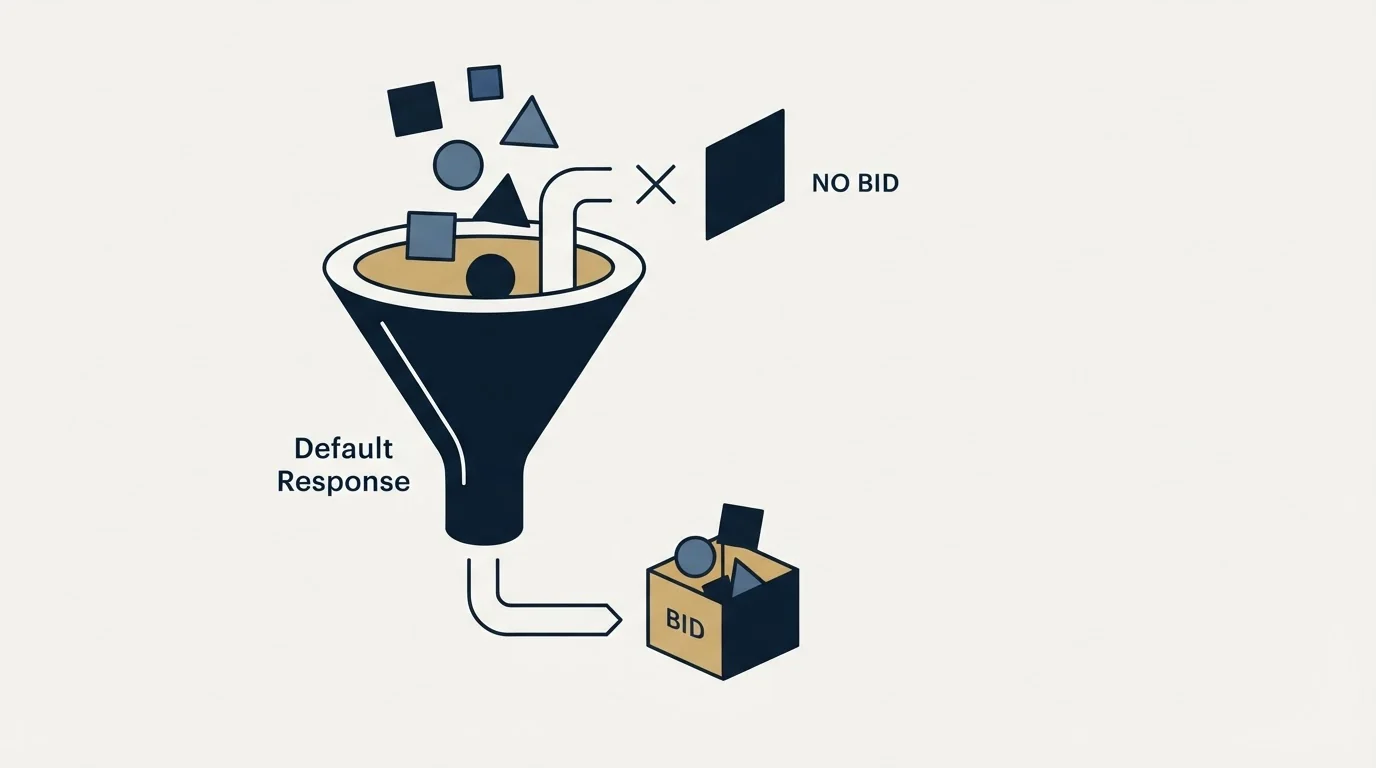
Deciding whether to respond is the highest-leverage moment in an RFP and it usually gets the least deliberate attention, because arriving feels like selection and the conversation moves immediately to logistics.
Standard qualification frameworks return yes here by construction, since fit and readiness are established by the document's existence. Judge four things instead: whether a requirement looks written around somebody else, whether any relationship predates the RFP, whether a mandatory criterion is genuinely out of reach, and whether a named person is reachable at all. Write the threshold down before an opportunity is in front of you, because a threshold written afterwards agrees with whatever the room already wants. Decline in writing with one honest reason.
If declining more often exposes how little else is in the pipeline, the constraint was never the proposal process. See what a first campaign produces for your market.
Terminology and purpose verified against Responsive's bid or no-bid decision guide as fetched on 23 August 2026. Publishers revise these pages; confirm current text before relying on it.
Frequently asked questions.
Frequently asked questions- What is a bid or no-bid decision?
- It is the decision on whether to respond to a request for proposal at all, made before any drafting starts. Responsive's guide notes the process goes by several names and is primarily called the bid/no-bid or go/no-go decision, and describes its purpose as weeding out unlikely deals so effort concentrates on the winnable ones.
- Why not just use our normal qualification framework?
- Because it was built for opportunities you started. BANT, MEDDIC and lead qualification all interrogate fit, readiness, budget and timing, and an issued RFP answers those by existing. What stays open is whether the process was wired for somebody else and whether you can reach anyone, and no standard framework asks either question.
- How can you tell an RFP was written for an incumbent?
- Look for requirements only one supplier meets: a named integration, a certification held by very few firms, or an unusual deployment model stated without justification. Specifications are often drafted with a preferred supplier in the room, or built from the incumbent's own documentation because it was the nearest thing to a specification available.
- Should we send a no-bid letter or just not respond?
- Send something short. A reply that declines, gives one honest reason and asks to be considered next cycle keeps you on the buyer's list, costs a paragraph, and occasionally surfaces flexibility that was not in the document. A generic capacity excuse reads as disinterest, so the reason has to be a real one.
About the author.

B2B cold email experts helping companies generate qualified leads through done-for-you outreach campaigns.
RevenueFlow Team
Explore more.
Ready to scale your outreach?
We build GTM engines that book real meetings. See the receipts.
Related articles.
Win Rate Benchmarks: Which Figures State a Population
A catalogue of the published average sales win rates, sorted by whether the page names the population behind its own number. Most do not.
Sales Enablement Charters: What the Published Ones Ask For
Six publishers set out what a sales enablement charter should contain. Five describe a document nobody can check, and one writes a definition with inspection in it.
Sales Kickoff Agendas: Five Published, Session by Session
Five publishers print a sales kickoff agenda. They agree on four blocks and disagree on session length, rehearsal and where the agenda comes from.
Sales Cycle Length Benchmarks: What Each Figure Counts
The published B2B sales cycle benchmarks, sorted by what each page says it counted. The same number means two different things in two of them.
Sales Comp Plan Design: What the Publishers Prescribe
Four publishers set out how to design a sales compensation plan. Here are their procedures, their components, and which of their ratios carry a population.
Sales Prospecting for Consulting Firms: Find the Event
Prospecting for a consulting firm: where triggers are published by practice, who inside the firm reads them, why alumni and referrals come first, when to skip it.