Pay per Appointment Lead Generation: Definition Over Price
A meeting is booked, accepted and nobody joins. Whether that appears on the invoice depends entirely on a definition most agreements never write down.
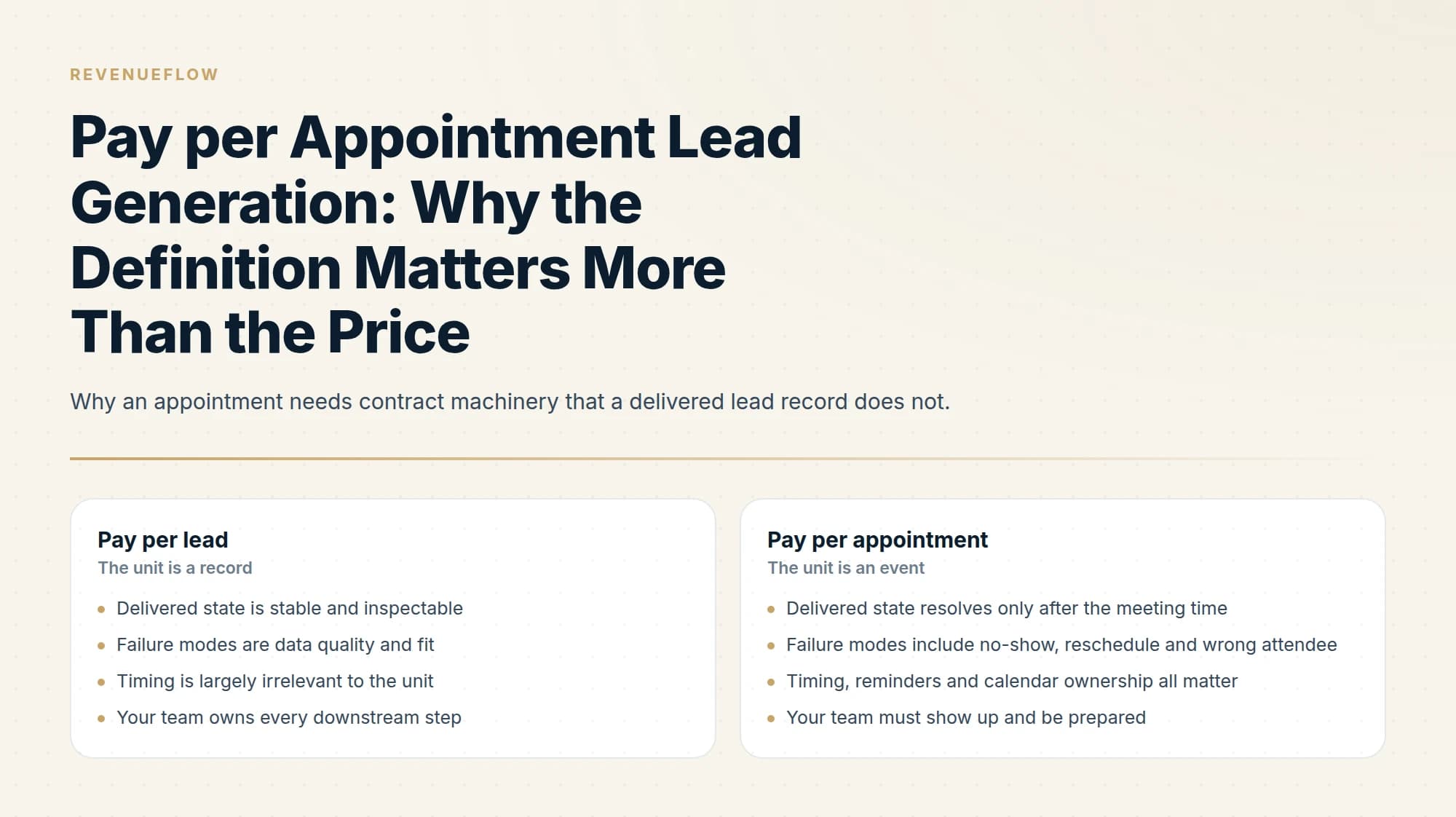
Pay per appointment bills on an event rather than a record, so the meeting definition governs everything. RevenueFlow bills against a five-point qualified meeting standard requiring agreed audience fit, a participant with responsibility for the area, an agreed business conversation, attendance and participation, and no prior disclosure as a customer or suppressed account.
Key takeaways
- An appointment can fail as a no-show, a reschedule or a wrong attendee, so it needs contract machinery that a delivered lead record never requires.
- RevenueFlow bills against a five-point qualified meeting standard, and all five points must hold, including attendance and participation.
- Budget, timing, decision authority and purchase intent are never conditions of billing. Those are discovered inside the meeting the client is buying.
- A held meeting counts unless the client flags it within three business days with a reason that maps to the written definition.
Reviewed and updated September 2, 2026
A meeting is booked for Tuesday at 10. The invite is accepted, the reminder goes out, and at 10 nobody joins. By Friday the vendor's invoice includes that meeting and the client's finance team has queried it. Both parties are reading the same agreement and both are confident. The agreement says "per appointment", and nowhere does it say whether an appointment is a calendar entry or a conversation.
That is the entire pay-per-appointment category compressed into one Tuesday. The unit being sold is an event involving two people, a time and a place, which means it can fail in ways a data record simply cannot. A contact record either exists or it does not. A meeting can be booked and not held, held and rescheduled, held with the wrong person, or held with exactly the right person who turns out to have been an existing customer all along. Every one of those cases needs an answer before launch, because after launch they are arguments.
What separates this from pay per lead
Under a pay-per-lead model, the vendor delivers something static: a record, a response, a scored contact. You can inspect it on arrival. If it fails your criteria, you say so and the record does not change while you decide.
Choosing between static records and live commitments comes down to who absorbs execution risk, which the economics of pay per lead pricing explains in full.
An appointment is a commitment by a third party who has no contractual relationship with either of you. The prospect can accept and forget. They can reschedule twice and then attend. They can attend and be the wrong person because their colleague forwarded the invite. The vendor controls the invitation and the qualification, and controls nothing about attendance beyond reminders and good scheduling hygiene.
- Delivered state is stable and inspectable
- Failure modes are data quality and fit
- Timing is largely irrelevant to the unit
- Your team owns every downstream step
- Dispute evidence is the record itself
- Delivered state resolves only after the meeting time
- Failure modes include no-show, reschedule and wrong attendee
- Timing, reminders and calendar ownership all matter
- Your team must show up and be prepared
- Dispute evidence is the invite, the attendance and the notes
The practical consequence is that the meeting definition is the contract. Price is a number you agree in an afternoon. The definition governs every invoice for the length of the engagement, and a vague one guarantees a monthly negotiation that neither side enjoys and neither side wins.
Because the same definition-first discipline applies at trade shows, conference lead generation cost per meeting explains how that unit is decided before the event even starts.
The standard we bill against

Rather than describe a hypothetical, here is ours. Our MSA qualified meeting standard has five points, and all five must hold for a meeting to be billable.
- Yes: The company is in a pre-approved audience and meets the agreed ICP criteria
- Yes: The participant has reasonable responsibility for or influence over the relevant business area
- Yes: The prospect agrees to a relevant business conversation
- Yes: The prospect attends and participates
- Yes: The prospect was not disclosed as an existing customer, active opportunity or suppressed account before outreach
Read point four carefully, because it settles the Tuesday problem. Attendance and participation are part of the standard, so a no-show is not a billable meeting under our terms. The unit is a conversation that happened.
Whether the model works at all is settled earlier, because the rate times meetings per closed deal is the figure a deal value has to repay.
Read point five as well, since it defines the boundary of responsibility on exclusions. Accounts disclosed to us before outreach as customers, live opportunities or suppressed names are excluded, and a meeting with one of them is not billable. Accounts nobody disclosed cannot be, because we had no way to know. That single word "disclosed" is why the suppression list belongs in onboarding rather than in the first invoice dispute.
Equally important is what the standard does not contain. Budget, timing, decision authority and immediate purchase intent are explicitly not conditions of billing. We do not accept BANT-style gates on billability, and the reason is structural rather than stubborn. Budget and timing are discovered inside a sales conversation, which is what the meeting is for. A standard that requires them before billing asks the outbound function to complete the sales process and then hand over a deal, priced as a meeting. Client-specific qualifying questions layer on top of the five points and never replace them, so a client who needs a particular condition satisfied writes it in as a sixth criterion rather than importing a framework wholesale.
Booking, and who owns the calendar
Two operating defaults follow from the standard, and both are worth stating because they are frequently the negotiation.
We book by default. A prospect meeting the agreed bar goes straight onto the calendar with no pre-booking client review hold. Every booking is flagged in the client channel as it lands, and the client can ask us to cancel any booking. The reason for this default is immediacy: responding to an interested prospect quickly is one of the largest levers on whether the meeting actually happens, and a review queue costs momentum on every single booking in order to protect against the rare miss that the cancel right already covers.
A client who wants a pre-booking review step can have one, and it should be time-boxed. An open-ended hold turns every warm prospect into a queue item and quietly converts a performance engagement into a coordination exercise.
Calendar ownership is the adjacent question and it deserves an explicit answer in the agreement. Whoever owns the calendar owns the confirmation sequence, the reminders, the reschedule handling, and the timezone arithmetic. Split that ownership and confirmations get sent twice or not at all. Decide it once, in writing, and make the owner responsible for the mechanics that follow from it.
No-shows and reschedules
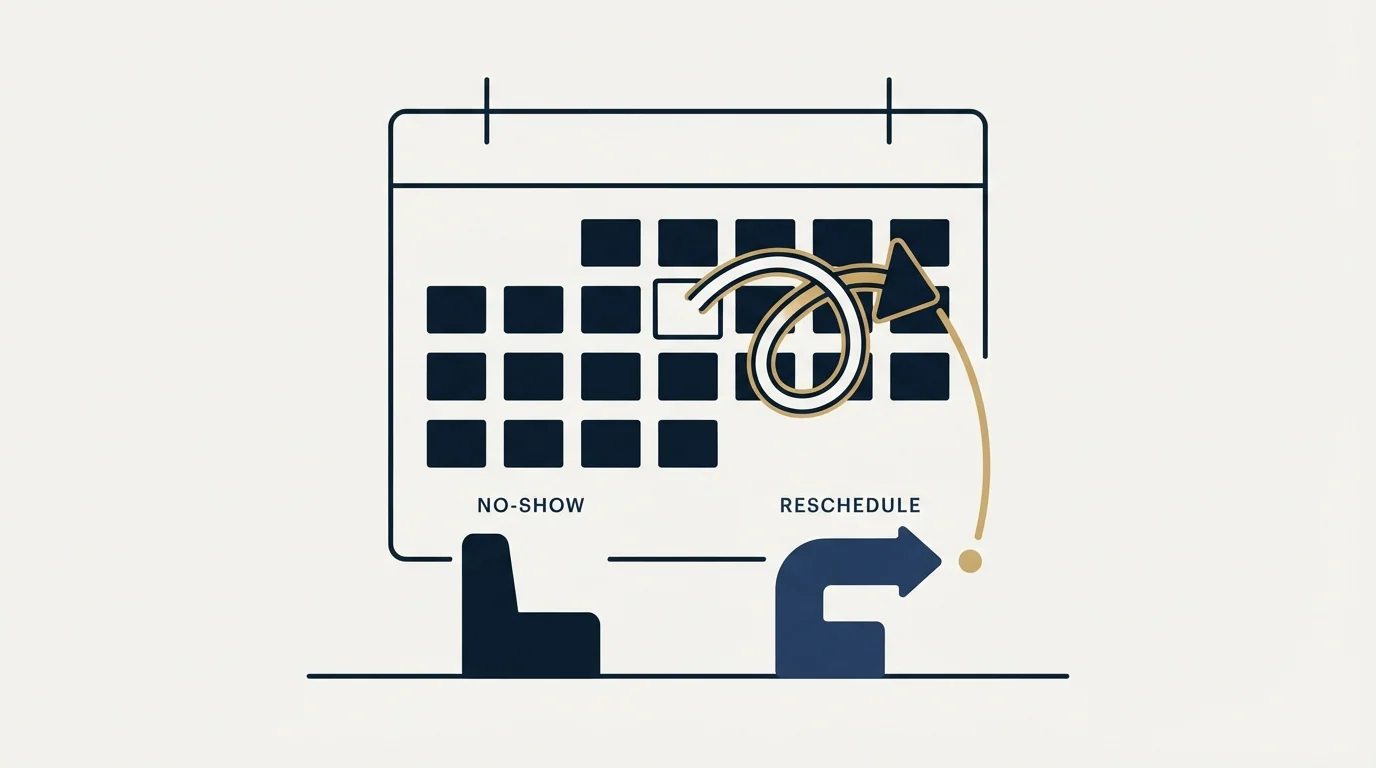
These are the two events that generate most of the friction, and both are resolvable in advance with a sentence each.
- Step 1Booked and flagged
The meeting is set against the written criteria and posted in the client channel as it lands, with the cancel right available immediately.
- Step 2Confirmed
The calendar owner runs confirmations and reminders. Reschedule requests are handled by the same owner rather than bouncing between parties.
- Step 3Held
The prospect attends and participates. Attendance is the point at which the unit becomes real under a held-meeting standard.
- Step 4Review window
A short, fixed number of business days in which the client can reject the meeting with a reason that maps to the written definition.
- Step 5Settled
Unflagged meetings count and appear on the invoice. Rejected meetings leave it. The invoice is never a fresh negotiation.
A no-show under a held-meeting standard is not billable, and the honest way to handle it is to re-engage the prospect and rebook rather than to argue. The rebooked meeting, if it holds and satisfies the five points, is a meeting.
A reschedule is not a failure at all and should not be treated as one. Prospects move meetings. The unit resolves whenever it holds, and a contract that penalises rescheduling encourages exactly the wrong behaviour, which is pressuring a prospect to keep an inconvenient slot they will then skip.
The case worth naming separately is a repeat no-show, where the same prospect books and misses more than once. Agree in advance how many attempts are made before the prospect is retired, so that neither side is unilaterally deciding when to stop.
The wrong-attendee case needs its own line too, because it splits into two very different situations that look identical on the calendar. A prospect who forwards the invite to a colleague with more direct responsibility for the area has substituted upward, and the meeting typically still satisfies the standard, since point two asks about responsibility and influence rather than about a specific named person. A prospect who sends a junior stand-in with no responsibility for the area has not, and that is a valid rejection against the written definition. Deciding which is which by reading the criteria takes seconds. Deciding it by argument takes a week.
The rejection window
A held meeting counts unless the client flags it within three business days with a valid reason. That default does two things at once.
It gives the client a real right of refusal, exercised while the meeting is fresh and the notes are readable. And it gives the engagement a settled state, since a meeting nobody flagged inside the window is closed rather than reopenable at invoice time. A rejection right with no clock is not a right, it is a permanent option, and it makes forecasting impossible for the party carrying the delivery risk.
What makes a rejection valid is the other half. A valid rejection maps to the written definition: wrong company profile, wrong role, an agreed exclusion, or a failed qualifying question. Those are checkable against the criteria both parties signed.
Subjective quality complaints are not valid rejections. "The call went poorly" and "they were not ready to buy" describe the sales conversation rather than the delivery, and a standard that allows them makes the vendor responsible for how your team sells. That distinction is uncontroversial before launch and heavily contested afterwards, which is precisely why it goes in writing before launch.
The same logic runs through the rest of our approach: criteria are agreed in writing before anything sends, and every campaign carries one message with no bump sequences or thread replies behind it, so a prospect who does not reply is not chased into a booking they did not want.
Setting it up so the invoice is boring

The goal of all of this is an invoice that both parties can predict a week before it arrives.
Do the definition work in the kickoff, not the first month. Write the company criteria, the roles that count, the qualifying questions, and the exclusions. Hand over the suppression list before launch: existing customers, live opportunities, partners and anything your team is already working. Name the person on your side who reviews bookings and holds the rejection window, and make sure that person is actually reachable inside three business days.
Then staff the output. A booked calendar that nobody attends from your side destroys value for both parties, and it is the failure mode buyers least expect to be theirs.
More on the category and how vendors differ sits in appointment setting companies, B2B appointment setting services and pay per appointment in B2B. If you are still deciding between buying meetings and buying leads, appointment setting versus lead generation covers that fork directly.
If you want to see our qualified meeting standard applied to your own market before committing to anything, you can see what a campaign would look like for your market.
Price the meeting last. Define it first, in writing, with attendance, exclusions and the rejection window all named, and the price becomes a straightforward number attached to a unit both sides can recognise on sight.
Frequently asked questions.
Frequently asked questions- Do you pay for a no-show under pay per appointment?
- It depends on whether the contract bills on a booked meeting or a held one. Booking is a moment and a calendar entry proves it, so no-show risk sits entirely with the buyer. Under our standard, attendance and participation are part of the definition, so a no-show is not billable and the correct response is to re-engage and rebook the prospect.
- What makes a meeting qualified?
- Under our standard, five points must all hold: the company is in a pre-approved audience meeting agreed criteria, the participant has responsibility for or influence over the relevant area, the prospect agrees to a relevant business conversation, the prospect attends and participates, and the prospect was not disclosed beforehand as an existing customer, active opportunity or suppressed account.
- Can we reject a meeting we did not like?
- You can reject any meeting that fails the written definition: wrong company profile, wrong role, an agreed exclusion or a failed qualifying question, flagged within three business days. Subjective complaints such as the call going poorly or the prospect not buying are not valid rejections, because they describe your sales conversation rather than the delivery you contracted for.
- Who books the meeting and manages reschedules?
- Whoever owns the calendar should own confirmations, reminders, reschedules and timezone handling, and the agreement should say which party that is. Splitting ownership causes duplicated or missing confirmations. We book qualified prospects straight onto the calendar, flag every booking in the client channel as it lands, and cancel any booking the client asks us to.
About the author.

B2B cold email experts helping companies generate qualified leads through done-for-you outreach campaigns.
RevenueFlow Team
Explore more.
Ready to scale your outreach?
We build GTM engines that book real meetings. See the receipts.
Related articles.
Win Rate Benchmarks: Which Figures State a Population
A catalogue of the published average sales win rates, sorted by whether the page names the population behind its own number. Most do not.
Sales Kickoff Agendas: Five Published, Session by Session
Five publishers print a sales kickoff agenda. They agree on four blocks and disagree on session length, rehearsal and where the agenda comes from.
Sales Cycle Length Benchmarks: What Each Figure Counts
The published B2B sales cycle benchmarks, sorted by what each page says it counted. The same number means two different things in two of them.
Sales Enablement Charters: What the Published Ones Ask For
Six publishers set out what a sales enablement charter should contain. Five describe a document nobody can check, and one writes a definition with inspection in it.
SDR Outsourcing for Commercial Insurance Agencies
What an outsourced sales development team may legally say for a commercial insurance agency, how it may be paid, and the expiration-date calendar it has to work.
Appointment Setting for Business Brokers: The Seller Meeting
What a bought meeting with a business owner has to be for a brokerage: the three-part qualification, the confidentiality rules, the licence line and the owner's reasons.